Is Wild Camping Legal in the UK? Fears, Facts & a Smarter Way to Start
Wild camping has always carried a certain magic.
The idea of walking into the woods, pitching a tarp or tent quietly, making coffee as the sun rises — that’s what draws many of us outdoors in the first place.
But in the UK, wild camping isn’t as simple as it sounds.
And for a lot of people, that uncertainty creates hesitation.
Why So Many People Feel Nervous About Wild Camping
Let’s be honest.
When the subject of wild camping comes up, the same questions appear:
Is it legal where I am?
Can I camp here without permission?
What happens if I get moved on?
Am I trespassing?
Will I upset a landowner?
In Scotland, access rights are clearer under the Land Reform (Scotland) Act.
In England and Wales, however, wild camping generally requires landowner permission, with only limited exceptions.
That legal grey area puts many people off before they even start.
It’s not a lack of interest.
It’s a lack of confidence.
The Reality: It’s Not About Rebellion
Wild camping shouldn’t be about “getting away with it.”
It should be about:
Respecting land
Leaving no trace
Understanding access rights
Being responsible
But when someone is new to camping or bushcraft, the fear of doing something wrong can outweigh the excitement of trying.
And that’s where many people stop.
What Is Nearly Wild Camping?
Nearly Wild Camping is a UK-based not-for-profit cooperative that connects campers with private landowners who are willing to host small numbers of campers on their land.
It isn’t a busy commercial campsite.
It isn’t uncontrolled wild camping.
It’s a middle ground.
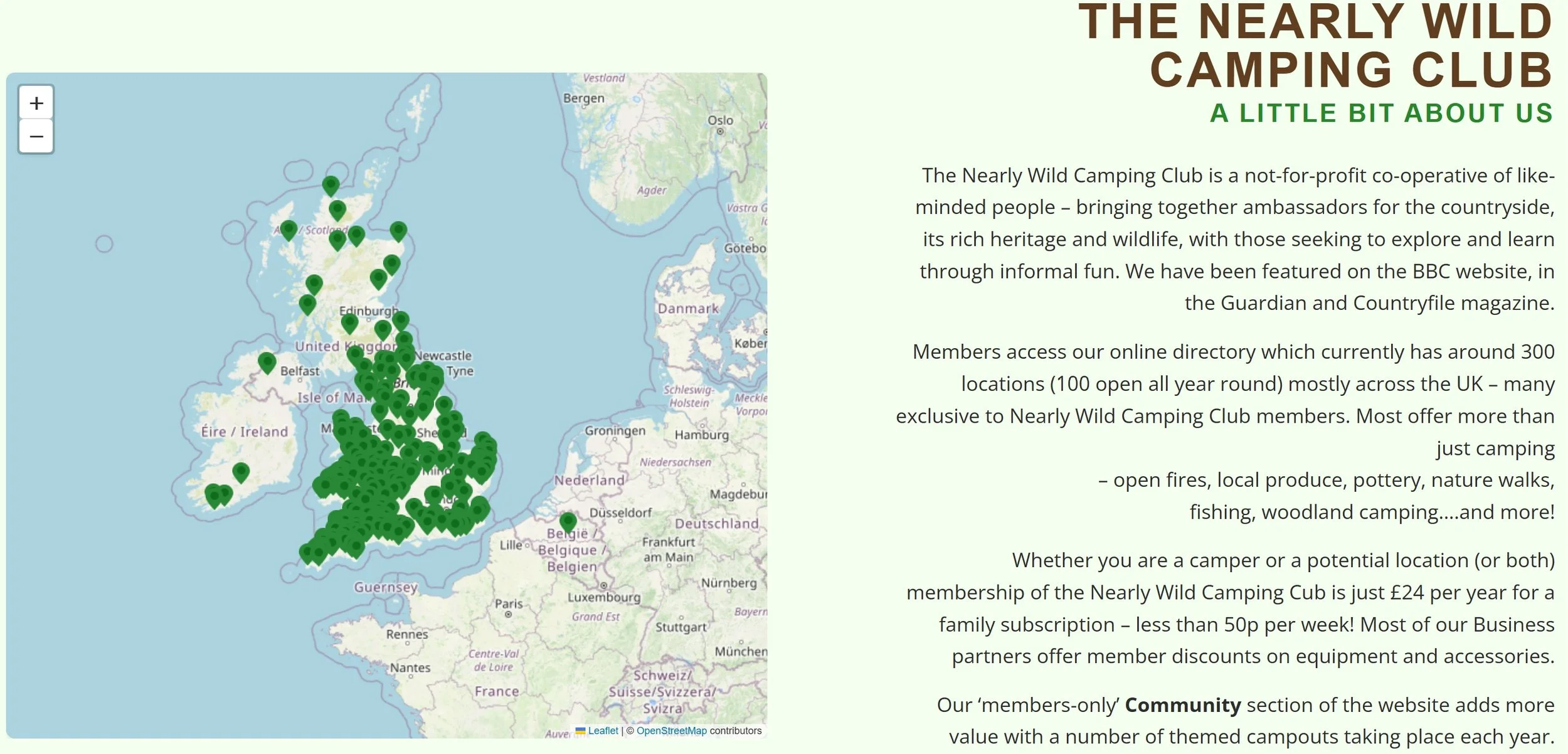
Members gain access to a directory of locations across the UK — woodland clearings, meadow edges, farm fields, quiet rural spots — where permission has already been granted.
That one detail changes everything.
No second-guessing.
No legal uncertainty.
No “are we allowed here?”
Why Nearly Wild Camping Works for Beginners
For someone who is:
New to bushcraft
Nervous about legality
Unsure about land access
Wanting a quieter alternative to busy campsites
Nearly Wild Camping offers a stepping stone.
You still get:
Seclusion
Nature
Simplicity
Minimal facilities
Space to practice skills
But without the stress of wondering whether you’re somewhere you shouldn’t be.
It allows people to build confidence gradually.
Building Confidence the Right Way
Confidence outdoors doesn’t come from jumping straight into the deep end.
It comes from:
Learning how to pack properly
Practising low-impact camping
Managing your cooking setup
Setting up a tarp in bad weather
Leaving a pitch exactly as you found it
Nearly Wild Camping provides a safe environment to learn those things.
For many, that first legal, low-pressure experience is what unlocks everything else.
Responsible Camping Matters
The more people understand:
Land access rules
Leave No Trace principles
Respect for landowners
Responsible fire management
The stronger the outdoor community becomes.
Nearly Wild Camping encourages responsible behaviour because it operates on trust between landowners and campers.
That trust is important.
And it’s something worth protecting.
Is It for Everyone?
Nearly Wild Camping typically operates through a membership model, giving access to the directory and community information.
It’s not free wild camping.
It’s not a festival campsite.
It’s a practical middle option.
For some people, that’s exactly what they need.
Final Thoughts
Wild camping in the UK isn’t black and white.
It requires awareness, respect and responsibility.
If you’ve always wanted to try camping in quieter, more natural locations but felt unsure about legality or confrontation, Nearly Wild Camping may be a sensible place to start.
It’s not about pushing boundaries.
It’s about building confidence.
And confidence outdoors changes everything.
Explore Nearly Wild Camping
You can learn more about their locations and membership options here:
https://nearlywildcamping.org/