Tom Brown Tracker Knife Review: Brilliant Survival Tool or Overhyped Sharpened Pry Bar?
The Tom Brown Tracker knife is one of the most divisive survival knives in the bushcraft world.
Some people see it as one of the most capable wilderness tools ever designed.
Others think it’s an overbuilt gimmick trying to do too many things at once.
Very few knives split opinion like the Tracker — and honestly, that’s probably part of why it became so iconic.
For years, this knife has had an almost mythical reputation online. Some people talk about it like the ultimate survival tool. Others dismiss it the moment they see the blade shape.
The truth, as usual, sits somewhere in the middle.
In this Tom Brown Tracker knife review, we’ll look at what it actually does well, where it struggles, and whether it makes sense for real-world bushcraft and survival use — especially in UK woodland conditions.
Quick Verdict
Pros
Extremely tough and durable
Excellent for heavy wood processing
Chops surprisingly well for its size
Unique multi-purpose design
Great for rough camp work
Cons
Heavy and fatiguing during long use
Thick blade struggles with fine carving
Awkward for food prep
Sawback divides opinion
Not ideal for lightweight bushcraft
👉 Best for: heavy camp work, survival use, static woodland setups
👉 Not ideal for: lightweight bushcraft, precision carving, minimalist carry
What Is the Tom Brown Tracker Knife? (Overview)
The Tom Brown Tracker knife was designed around the survival teachings of Tom Brown Jr and later manufactured by TOPS Knives.
It became especially well known after appearing in The Hunted.
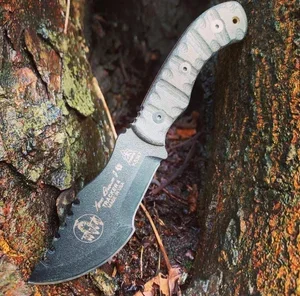
The full-size Tracker is a large fixed blade with one of the most unusual designs ever put into mainstream production.
Instead of a single cutting edge, the blade includes separate working sections for:
chopping
carving
scraping
sawing
notching
drilling
The original Tracker School material even explains how different parts of the blade were intended for tasks like hide scraping, friction fire work, and shaping wood.
This isn’t a traditional knife.
It’s designed as a multi-purpose survival tool system.
The Design: Why It Looks So Strange
At first glance, the Tracker barely resembles a normal bushcraft knife.
It features:
a forward-heavy chopping section
a curved carving edge
a sawback spine
a thick reinforced tip
a quarter-round section for scraping
The full-size version is around 12 inches long with a 6mm (¼ inch) 1095 carbon steel blade.
That thickness and weight are a huge part of both the praise and criticism.
Compared to something like a Mora, it feels less like a knife and more like a compact survival tool — or a sharpened pry bar.
Why Some People Love the Tracker
People who like the Tracker usually love it for one main reason:
👉 It feels capable.
The knife is:
tough
aggressive
confidence-inspiring
extremely solid
It can:
baton hard wood
chop branches
scrape bark
process firewood
handle rough camp use
…and it never feels fragile.
Many owners treat it less like a knife and more like a compact woods tool.
Interestingly, a lot of users who end up liking the Tracker didn’t like it at first — it’s a design people often grow into.
Why So Many Bushcrafters Dislike It
This is where opinions split hard.
1. It’s Heavy
At around 600g, the Tracker is significantly heavier than most bushcraft knives.
Compared to:
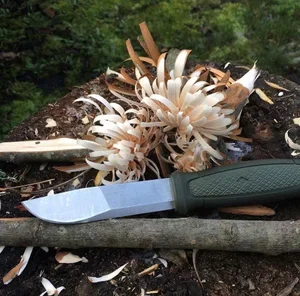
Mora Companion
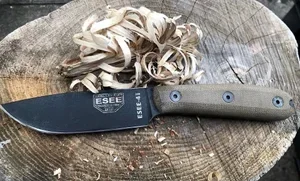
ESEE 4
Woodlore-style blades
…it feels large and fatiguing over time.
2. Poor for Fine Bushcraft Tasks
The thick blade struggles with:
feather sticks
detailed carving
notches
food prep
Many users describe it as:
clumsy
unbalanced
awkward
Compared to a Scandi grind knife, that criticism is fair.
3. The Sawback Divides Opinion
Some users appreciate the extra function.
Others ignore it completely.
Even the original design acknowledges it’s only useful for small work.
4. It Tries to Do Everything
This is the biggest criticism.
Instead of carrying:
a knife and saw
or a knife and axe
…the Tracker combines everything into one tool.
The trade-off?
👉 Good at many things
👉 Excellent at very few
Tracker vs Traditional Bushcraft Knives
Compared to traditional bushcraft knives like a Mora or Woodlore-style blade, the Tracker sits at the opposite end of the spectrum.
A Mora is:
light
precise
easy to control
The Tracker is:
heavy
aggressive
built for rough work
Neither is “better” in every situation — they just serve different purposes.
This is why many bushcrafters prefer a simple knife + saw setup instead of a single oversized tool.
The “Movie Knife” Effect
After The Hunted, the Tracker developed an almost mythical reputation.
This created a divide:
some people bought it expecting a perfect survival tool
others pushed back hard against the hype
That backlash still follows the Tracker today.
Is the Tom Brown Tracker Knife Practical in the UK?
This is where things get realistic.
In UK woodland conditions, the Tracker can:
process wood
baton effectively
scrape tinder
handle rough camp tasks
But for:
feather sticks
fine carving
food prep
long-distance carry
…simpler knives usually perform better.
That’s why many UK bushcrafters prefer:
Mora knives
Woodlore-style blades
Scandi grinds
compact fixed blades
The Tracker suits:
static camps
survival setups
heavy woodland work
…but not lightweight bushcraft.
What the Tracker Does Better Than Most Knives
To be fair, the Tracker excels in some areas:
heavy wood processing
chopping for its size
durability
scraping bark and tinder
aggressive camp work
It also feels almost indestructible.
And whether people love it or hate it, it’s instantly recognisable.
Final Thoughts
The Tom Brown Tracker knife is one of the most controversial survival knives ever made.
It’s not the ultimate “one knife solution.”
But it’s also not useless.
It’s a specialised tool built around a specific survival philosophy.
If you expect a traditional bushcraft knife, you’ll probably dislike it.
If you understand its strengths, it makes more sense.
In the end, its popularity comes down to one simple fact:
👉 It’s different.
And that keeps people talking about it.
FAQs
Why do people dislike the Tom Brown Tracker?
Most criticism focuses on its weight, thick blade, and poor performance in fine carving tasks.
Is the Tom Brown Tracker good for bushcraft?
It handles heavy work well, but simpler knives are better for carving, feather sticks, and lightweight use.
Is the Tracker knife practical?
It works well as a heavy-duty camp and survival tool, but has limitations for minimalist setups.
Who makes the Tom Brown Tracker?
The Tracker knife is manufactured by TOPS Knives, based on Tom Brown Jr’s design.