
What’s in My EDC Stop Bleeding Kit?
My everyday first aid loadout for serious bleeding, injuries and emergencies
I’ve been putting together an EDC first aid kit designed to deal with everything from everyday cuts and minor injuries through to serious bleeding emergencies.
Rather than buying a ready-made kit and leaving it untouched, I’ve built and changed mine over time as I’ve learned more about first aid and tried different equipment.
The main focus is bleeding control, with a tourniquet, wound-packing gauze, haemostatic dressing and pressure dressing, but I also carry equipment for smaller wounds, burns and general first aid.
In this article I’ll show you exactly what I carry, why each item has earned a place in the kit, and some of the changes I’ve made along the way.
Important: This is my personal first aid setup and is not a substitute for proper first aid training or professional medical advice. Equipment such as tourniquets and wound-packing materials should be used with appropriate training.
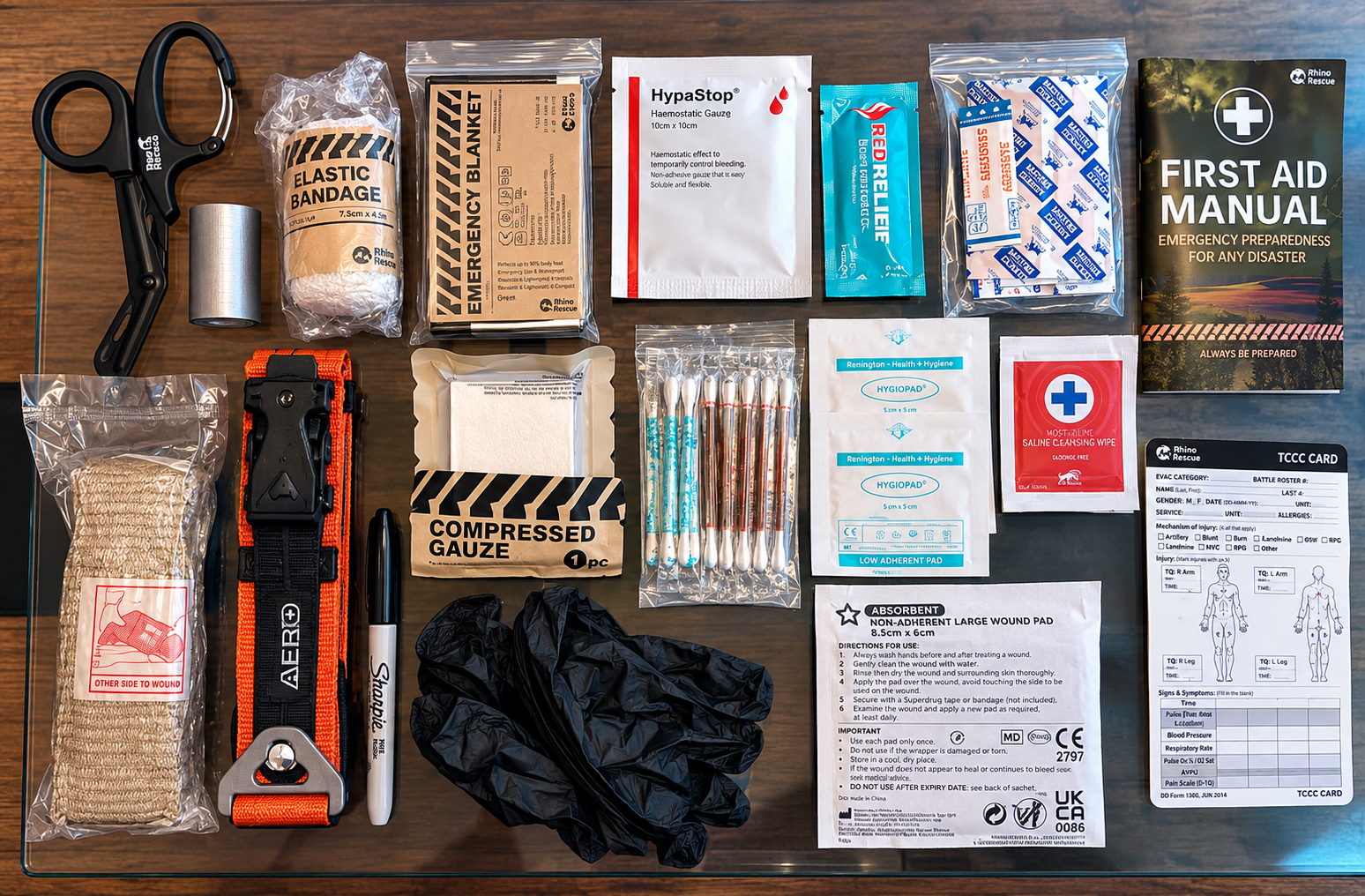
My current EDC first aid and bleeding-control loadout.
My EDC First Aid Kit at a Glance
I’ve divided the kit into four main areas: major bleeding control, everyday wound care, tools and PPE, and emergency information. Some items overlap, but the priority is keeping the equipment compact, accessible and useful in a genuine emergency.
Major Bleeding Control
Serious bleeding is the main reason I built this kit. My aim is to have several options available depending on the type and location of the injury, rather than relying on one piece of equipment.
The core of my bleeding-control setup consists of a tourniquet, wound-packing gauze, haemostatic dressing and pressure dressing.
RapidStop Tourniquet – My Primary Tourniquet
The tourniquet in my EDC kit is now the RapidStop, which came from an AERO Healthcare RapidStop Bleed Control Kit.
I previously carried a Rhino Rescue tourniquet as my main option, but that has now moved to a secondary role. After trying the RapidStop, I preferred its ratcheting design and found it straightforward to operate.
Rather than using the familiar windlass found on many tourniquets, the RapidStop uses a ratcheting lever to progressively tighten the strap. It also has a quick-clasp buckle and a dedicated area for recording the time the tourniquet was applied.
For me, this is exactly the sort of equipment that belongs in an emergency kit: compact, accessible and something I can regularly practise with rather than simply carrying it and hoping I never need it.
Important: A tourniquet is emergency bleeding-control equipment. Get appropriate first-aid training and follow the manufacturer's instructions rather than relying on an article like this to learn how to use one.
Wound Packing – Compressed Z-Fold Gauze
For serious bleeding where a wound is suitable for packing, I carry sterile compressed Z-fold gauze. It packs down very small, so it takes up very little room in my EDC kit while still giving me a useful amount of gauze when opened.
I chose Z-fold gauze because it is compact, easy to deploy from the packet and designed to be fed out progressively rather than having a loose roll of gauze to manage.
This is one of the items I consider part of the serious bleeding-control side of the kit, alongside my tourniquet and pressure dressings.
HypaStop Haemostatic Gauze Dressing
I also carry a 10 cm × 10 cm HypaStop haemostatic gauze dressing. According to the packaging, it has a haemostatic effect intended to temporarily control bleeding and is a non-adhesive, flexible dressing.
This gives me another bleeding-control option alongside the standard compressed gauze rather than relying on one type of dressing for everything.
Training matters: Wound packing is an emergency first-aid skill and isn't something I recommend learning from a website article. Get proper training so you know which wounds are appropriate to pack and how to control serious bleeding safely.
Pressure Dressings & Bandages
Once bleeding has been controlled, I want something in the kit that can apply and maintain pressure over a wound. I carry a couple of different options rather than relying on a single dressing.
Emergency Pressure Dressing
The larger sterile dressing in my kit is similar in principle to an Israeli-style emergency bandage. It combines a wound pad with a long elasticated bandage, allowing it to be secured firmly over an injury.
I’ve removed the outer packaging to make it quicker to access, while the dressing itself remains sealed in its sterile inner packaging.
For me, this is one of the core items in the bleeding-control part of the kit because it gives me a way of covering a wound and maintaining pressure after the initial bleeding has been dealt with.
Elastic Crepe Bandage
I also carry a 7.5 cm elastic bandage. This is a much more general-purpose item and can be useful for securing dressings and providing support where appropriate.
It doesn't replace the dedicated emergency pressure dressing, but it gives the kit more flexibility without taking up much space.
Smaller Wounds & Everyday First Aid
Although serious bleeding control is the main reason I built this kit, I’m far more likely to encounter smaller cuts, grazes and minor wounds. I therefore wanted enough basic first-aid equipment to deal with those situations without needing a completely separate kit.
Low-Adherent Dressings & Large Wound Pad
I carry sterile low-adherent dressings for covering smaller wounds, along with a larger 8.5 cm × 6 cm absorbent non-adherent wound pad.
Having different sizes gives me more flexibility depending on the injury, while the non-adherent design helps avoid having the dressing stick directly to the wound.
Plasters
There are also several individually wrapped adhesive plasters in the kit. They're nothing exciting, but they're probably among the items I'm most likely to actually use.
Small cuts and scrapes don't need the serious bleeding-control equipment, so carrying a few basic plasters makes the kit much more useful day to day.
Wound Cleaning
For basic wound cleaning I carry a saline cleansing wipe, along with several snap-activated applicators.
Some of the applicators contain alcohol and others contain iodine. When snapped, the liquid flows into the cotton tip ready for use. They're tiny, individually packaged and take up very little room in the kit.
Disposable Gloves
Several pairs of nitrile gloves are packed into the kit as well. They're there to provide a barrier between me and blood or other bodily fluids when helping somebody.
For something so small and lightweight, gloves are one of the first-aid items I definitely don't want to leave out.
Burns & Other Useful Equipment
Not everything in my EDC first aid kit is specifically for bleeding. I’ve included a few additional items that take up relatively little space but make the kit more useful across a wider range of situations.
Burn Relief Gel
I carry a small sachet of burn relief gel for minor burns. It gives me a compact option for the kit without carrying a larger burn dressing.
For burns, the priority is still appropriate first aid — including cooling a thermal burn with cool or lukewarm running water where available — rather than relying on the gel alone.
Trauma Shears
My Rhino Rescue trauma shears are kept where I can get to them quickly. They're useful for cutting clothing or dressings when access to an injury is needed.
Keeping them on the outside of the pouch also means I don't have to empty the kit to find them.
Duct Tape
A small roll of duct tape gives me a versatile way of securing equipment or dressings when needed. It's one of those simple multipurpose items that takes up very little room.
Emergency Blanket
I carry a 160 × 210 cm emergency foil blanket. After a serious injury, keeping someone protected from the environment and preventing unnecessary heat loss can be important while waiting for professional help.
Permanent Marker
The permanent marker has several potential uses, but one important reason it's in the kit is so information such as the time a tourniquet was applied can be recorded.
First Aid Information
Finally, I carry a small first-aid manual and TCCC casualty card. They're lightweight and give me somewhere to record or reference useful information in an emergency.
Why I Built the Kit This Way
My aim with this kit is simple: carry enough equipment to deal with everyday injuries while also having proper bleeding-control equipment available for a more serious emergency.
The contents will probably continue to change as I gain more first-aid training, practise with the equipment and find better ways of organising everything.
Most importantly, I don't want to just own the equipment — I want to understand what I carry and regularly practise the skills needed to use it.
Final Thoughts
No first aid kit can replace proper training, and simply carrying a tourniquet or wound-packing gauze doesn't mean you know how to use it.
For me, building this EDC kit has become part of learning those skills. I'll continue testing the layout, practising with training equipment and updating the kit as I learn more.
Hopefully I'll never need the serious bleeding-control equipment — but I'd rather have the equipment and the training than find myself wishing I did.
My EDC First Aid Kit – Quick Checklist
Major bleeding control
RapidStop tourniquet
Z-fold compressed wound-packing gauze
HypaStop haemostatic gauze dressing
Emergency pressure dressing
Elastic bandage
Everyday first aid
Low-adherent sterile dressings
Larger non-adherent wound pad
Adhesive plasters
Saline cleansing wipe
Alcohol and iodine snap applicators
Burn relief gel
Tools & emergency equipment
Trauma shears
Nitrile gloves
Permanent marker
Duct tape
Emergency foil blanket
TCCC casualty card
First-aid manual
Keep Learning, Keep Practising
First aid equipment is only useful if you know how to use it. If you're building your own emergency kit, I'd recommend getting recognised first-aid training and regularly practising with dedicated training equipment rather than opening or using the emergency supplies you rely on.